



Companies at the growth stage tend to face a common problem: choosing the right ERP and implementing it successfully. It’s essential to keep the data clean, the reports timely, and the processes consistent as the business grows faster than the team can keep up.
Odoo gives you the infrastructure for that. AI agents give you the capacity. AI doesn’t replace your people, but helps them get tasks done faster. In this article, we’ll explain how integrating AI agents—Claude-powered AI agents, specifically—directly into Odoo environments can help you work more effectively, drawing on our practical experience and real use cases.
What Is an AI Agent in the Context of Odoo?
An AI agent is a configured software layer (in SmartTek’s case, powered by Anthropic’s Claude) that connects to your Odoo database, understands its structure, and can execute or assist with tasks based on plain-language instructions. What makes this useful inside Odoo is business context. The agent isn’t operating in a vacuum; it understands how your modules relate to each other, what your field names mean, and how your data is structured.
Why AI Agents for Odoo Are a Game-Changer
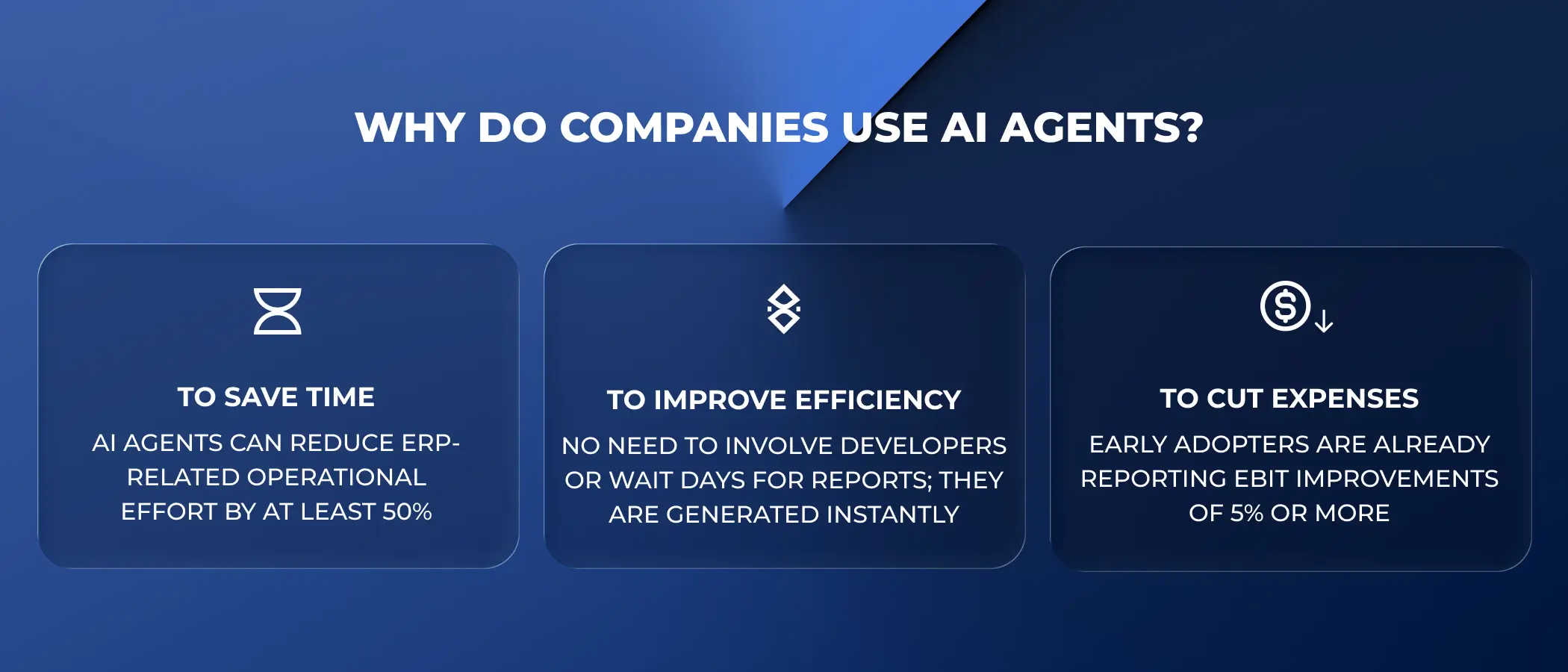
Most companies aren’t struggling with Odoo itself but with the gap between what the system can do and what their team has the capacity to maintain. And they decide to integrate AI in Odoo ERP for three main reasons.
Reason #1: To Save Time
Routine tasks, like data entry, normalization, report preparation, consume an unfairly large amount of time. For example, one of our clients had 15,000 products in their Odoo system that needed to be reviewed, categorized, and cleaned up. Done manually, that’s weeks of work, even for someone with deep system knowledge.
Meanwhile, research shows that AI agents can reduce ERP-related operational effort by at least 50%. After migrating to Odoo, our client completes tasks that used to take around three hours in minutes.
Reason #2: To Save Money
Companies tend to keep dedicated specialists—or entire teams—to prepare reports, normalize data, and maintain records that everyone else lets slide. They’re dealing with fixed costs for the work that doesn’t scale and excessive access risks to sensitive data on top of that. AI-integrated ERP systems come with higher security and efficiency: early adopters are already reporting EBIT improvements of 5% or more.
Reason #3: To Improve Efficiency
Getting a profitability breakdown by customer, vendor, or product requires pulling from multiple models and knowing exactly where to look. Most teams still use spreadsheets for managing this data. ERP is supposed to fix this. Yet, there’s a common sad scenario: a new platform goes live, the first request takes eight hours, and the report ends up being built in a spreadsheet—again.
But AI is configured against your actual data. A manager can describe what they need in plain language and get a structured output. With Odoo custom reporting AI, there’s no need to involve developers or wait days for a report. Odoo Agents make your work actually flow.
Practical Use Cases, Real and Proven
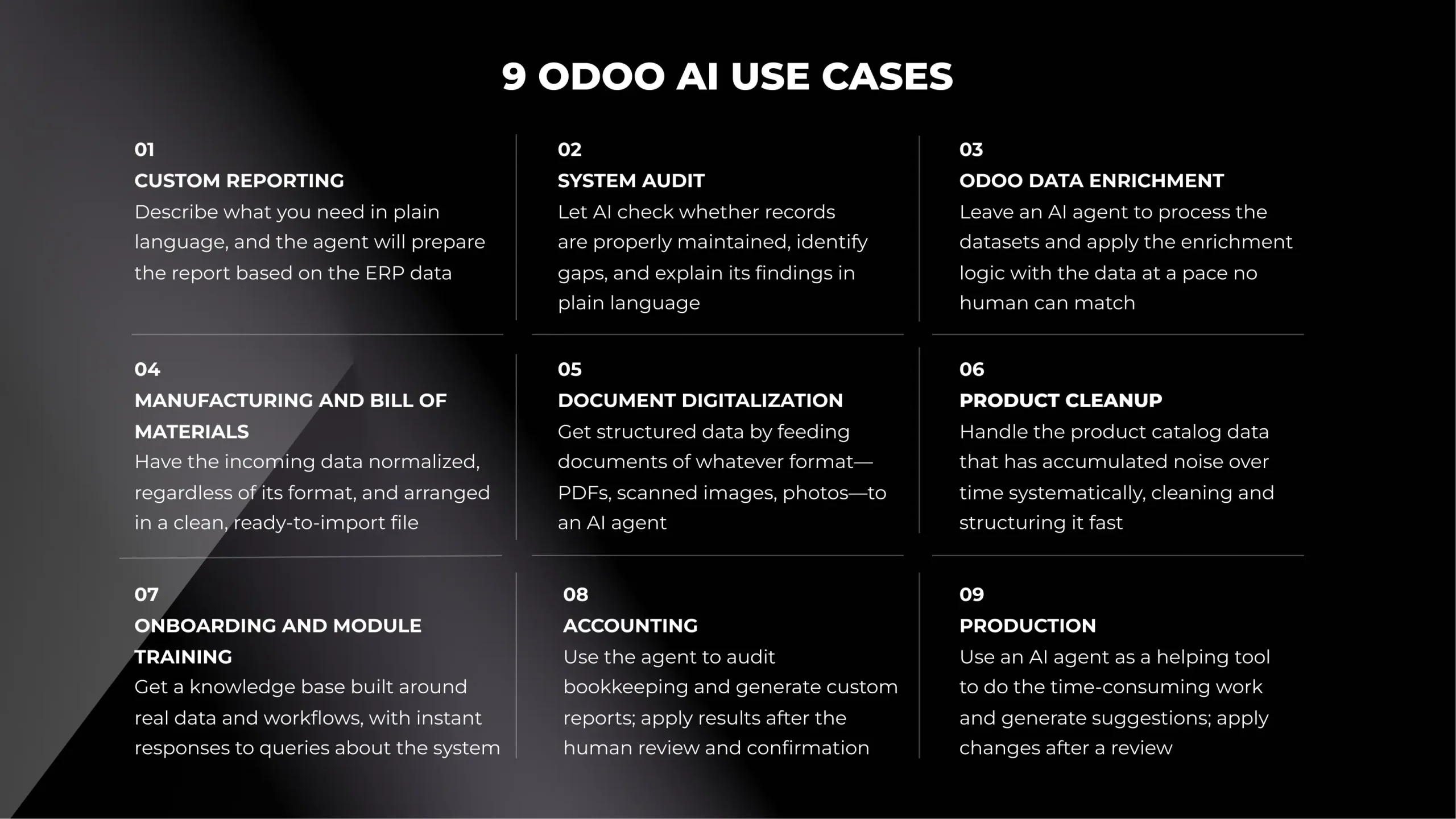
All Odoo AI use cases in this section come from an actual client’s story and are a good starting point for those uncertain about where to apply smart agents. If you recognize your case or come up with one while reading, feel free to reach out and discuss it in more detail.
Custom Reporting
Preparing a report for a manager normally means involving a developer or analyst, waiting for availability, and going back and forth on the scope until the output matches what was actually needed. Odoo automation with AI reshapes this process. A user describes what they need in plain language. The agent queries the relevant models, pulls the data, and helps prepare the report directly, without a ticket, a queue, or a translation layer.
System Audit
The AI works like an in-house accountant or auditor with full access to your database. It checks whether records are properly maintained, identifies what’s missing or inconsistent, and explains its findings in plain language (flagging issues and explaining why they’re a problem).
Let’s say you need to verify that customer records are complete and correctly structured. Odoo has deduplication tools for surface-level matching. An AI agent can reason across the data—checking whether customer records are properly filled in or identifying duplicates and overlapping contacts. Odoo has its own mapping tools, but an AI agent is configured specifically for each client’s situation.
Odoo Data Enrichment
Suppose a company has an existing list of customers, vendors, or products and wants to make it more useful by adding images, writing richer descriptions, and optimizing content for search. Going through records one by one is the kind of work that takes forever. An AI agent processes the dataset, applies the enrichment logic, and works through the list at a pace no human can match. It handles the volume while the team reviews and approves.
Manufacturing and Bill of Materials
A head of engineering sends over an Excel file—or sometimes something closer to a handwritten note from the shop floor—listing the products they need a bill of materials for. Done manually, building that BOM is hours of cross-referencing. Do these components already exist in the system? Are there vendors for them? Is there pricing history?
For manufacturing companies using Odoo, it’s much easier. An AI agent normalizes the incoming data regardless of format, checks it against what’s already in your ERP, identifies gaps, and prepares a clean, ready-to-import file. What would take an engineer most of a day takes Odoo AI for manufacturing bill of materials a fraction of that time, and it handles the inconsistent input formats that are common in how this data actually arrives.
Document Digitalization
Vendors send documents in whatever format is convenient for them: PDFs, scanned images, sometimes a photo taken by a delivery driver of a handwritten delivery note. An AI agent reads the document, determines its type, finds the matching purchase order in Odoo, maps the line items, and flags anything that doesn’t reconcile. The output is structured data ready to go into the system. Yes, a person drops in a document and gets back a completed record.
Product Cleanup
Over time, product catalogs accumulate noise. Duplicates, discontinued items that were never archived, inconsistent category structures, products with missing data, and similar items create a complete mess in records. An AI agent can handle it all systematically, identifying what’s active and what isn’t, what’s generating margin and what isn’t, where duplicates exist, and what should be consolidated or archived.
Onboarding and Module Training
When a client installs a new module—a QA workflow, a specialized worksheet, a new operational process—the usual path is generic documentation that may or may not reflect how their specific system is configured. The agent replaces that with something more useful: a knowledge base built around the client’s real data and workflows.
With Odoo AI integration, users can ask how something works, walk through a process step by step, or get help with a task they haven’t done before. All answers are grounded in their system instead of a general guide written for a default installation.
Accounting
The agent is used in a sandbox environment to audit bookkeeping and generate custom reports often pulling from several models simultaneously. For example, it can extract profitability by customer, vendor, or product mix. The outputs are reviewed and confirmed by the team before anything is applied manually to production. The AI surfaces the analysis, and a person makes the call.
Production
An AI agent on production is a helping tool, not an execution tool. Let’s say a call comes in via IP telephony. A user uploads the recording. The agent listens, summarizes the conversation, and suggests the next steps. But if those steps involve changes to accounting records, product data, or valuations, they are made manually by a person after review.
How We Make Sure AI Agents Don’t Have a Chance to Disrupt Your Daily Operations
Work process disruptions during AI implementation are a valid concern, but not with an experienced Odoo partner by your side. So, how to use AI agents in Odoo safely?
To begin with, our team has solid experience in AI implementation. We act as your business consultants and can advise which Odoo modules and processes would benefit the most from AI agents. In most cases, only specific parts of the system will be affected.
We work only with verified and trusted agents—specifically, Anthropic’s Claude. The reason is simple: Claude does not train on client data. It is guaranteed at the enterprise API level, meaning your business information is never used to improve the model. It comes with built-in constraints against destructive or unauthorized actions, which matter when an AI operates inside a live business system.
Most importantly, we implement AI agents in a controlled sandbox environment, equipping them with specific skills. The AI you get will generate the info that’s fit for your business requirements and needs. It won’t be connected directly to the production environment by default to avoid any interference.
When a production connection is necessary, the AI is strictly limited to the access rights of the user operating it. This is enforced at the user permissions level. We also configure logical restrictions to prevent bulk changes or other high-risk actions. If something goes wrong on the AI side, it does not affect the client’s production environment or their software.
We set up agents in a way to not modify client data and does not use it for any external purpose. All work runs through SmartTek’s own servers or locally. No client data ever passes to third-party services. Finally, we can set up an AI-assisted CRM audit in Odoo, and your agent will also monitor users for proper access rights.
| Sandbox | Production | |
| Data changes | Full access | Read-only by default |
| AI actions | All testing happens here | Strictly limited helper role |
| Accounting edits | AI-drafted, reviewed by a human | Manual only, never by AI |
| Risk operations | None | Near-zero (permissions-bound) |
Conclusion
Execution is where most ERP investments either pay off or quietly deteriorate the efficiency of daily operations. Clean data, consistent processes, and timely reporting are the foundation that is a must-have, but often complex to set up. And they’re the attributes separating companies that get value from Odoo from those still working around it.
AI agents are the infrastructure for building and maintaining the mentioned foundation with minimal effort. They work within your access controls, inside your environment, on the tasks your team shouldn’t have to handle manually. If you’re running Odoo and wondering how to make the most of this system, AI agents are a good place to look. Reach out to discuss secure AI integration for Odoo ERP.

 view the post