






The average cost of a single data breach is $4.4 million. The stakes are high, and most companies already know that security audits are crucial. However, they rarely understand what happens after they contact an auditor. They start wondering:
- How to prepare for a security audit?
- What information will auditors require? Will they need access to our source code, production, etc.?
- Who from our team has to participate in the process?
- Will the audit touch our release schedule, and how long will it take?
The concerns are understandable. In this post, we address them all and discuss what to expect from a cyber security audit and the specific deliverables you will receive.
When Do Companies Need a Security Audit?
In our experience, companies seek a security audit to achieve certain business milestones or to stay ahead of evolving security risks. The most common scenarios are as follows:
- They are preparing to onboard an enterprise-grade customer
- They are about to release a new product, the latest version of their existing product, or a major feature
- They are migrating their infrastructure or expanding their solution
- They are preparing to satisfy regulatory requirements, including ISO 27001, SOC 2 Type 2, and others
- They need to handle independent security assessments as requested by their investors or partners
- They need to check whether their architecture is secure
- They have already experienced a security breach and need to understand what went wrong
Speaking of security breaches, 31% of them start with software vulnerabilities. According to Blaze Information Security, the most common 10 vulnerabilities discovered in ISO 27001 penetration tests include:
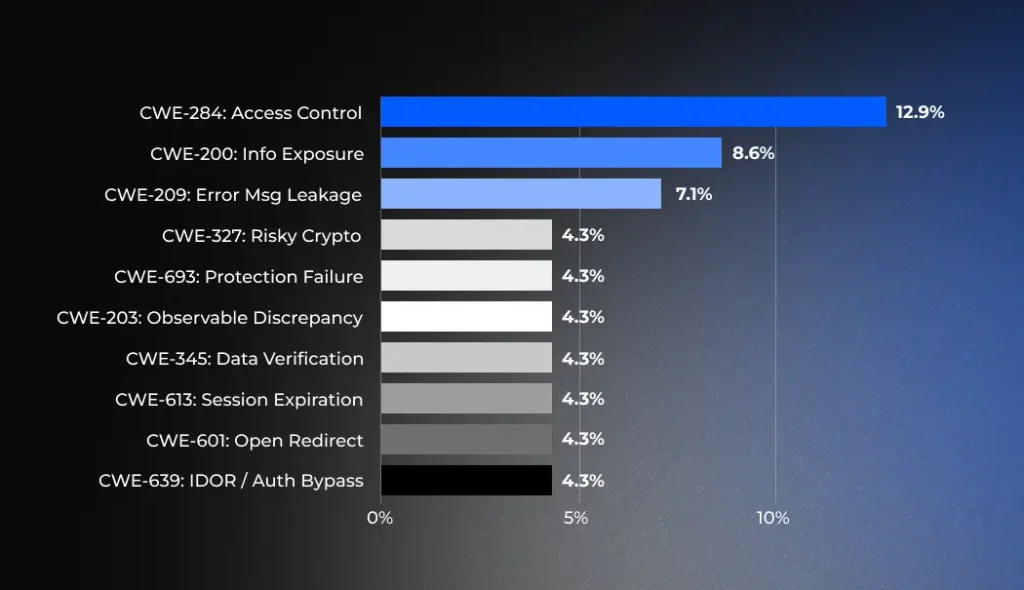
If you want to expose the above vulnerabilities before it’s too late, or have other motivations for a security assessment, you should start with the prep work long before the first actual check.
What Happens Before the Security Audit?
A cyber security audit never starts with vulnerability scanning or penetration testing. It starts with a conversation. If an auditor moves straight into scanning without bothering to learn what your business actually does and needs, you’re getting a generic review that hardly does anything to improve your security posture.
Before any technical work begins, a discovery and scoping process takes place.
1. Discovery Meeting and Business Goals
First, the audit team hops on a call with your technical leaders (usually the CTO or Head of Infrastructure). The purpose of this meeting is to understand your business logic. Auditors typically need to know:
- Why have you requested a security audit in the first place?
- What data are you trying to protect? (for example, healthcare records, financial transactions)
- Who are your users, and how do they access the system?
- What is the underlying business goal? (for example, migrating from legacy infrastructure, rolling out new product features)
- What security incidents or vulnerabilities have you already experienced? (if any)
- What are your deadlines for a security audit?
This conversation shapes the entire collaboration. A startup launching a new product has different priorities from a SaaS company onboarding its first enterprise client.
2. Architecture Overview
The next thing your auditors want to know is your environment. You will normally be asked to share:
- Architecture diagrams
- Data flow maps
- Cloud providers, third-party integrations, and services in use
- Application components
- Deployment environments
- Authentication methods
- Existing security controls
A professional vendor will provide you with a technical questionnaire, making it easier for you to describe your entire stack. It’ll typically include:
| Area | Typical questions |
| Infrastructure | What cloud providers or data centers do you use? |
| Access | How are user accounts managed? Who has access to what? What authentication measures are enforced? |
| Development | What development methodology does your team use? Do you have any specific code review requirements? |
| Monitoring | What logging and monitoring tools does your team use? |
| Compliance | What compliance standards do you already adhere to? What standards should you follow? |
| Previous audits | Have you completed a security audit or another type of assessment before? |
3. Defining the Scope
This is one of the most important stages within the security audit methodology.
Auditing everything is often a flawed strategy. It drains your budget and barely secures anything. A good audit requires defining exact boundaries, which is precisely the scoping stage. It covers the following:
- Identifying critical systems. You map out the assets that matter most: the specific databases, microservices, apps, or APIs where your most sensitive data is.
- Agreeing on boundaries. You explicitly list what is in scope and what is out of scope. For example, you can state that the third-party payment gateway you use is out of scope, but your API integration with it is highly in scope.
- Choosing testing environments. You decide exactly where the testing happens. In most cases, testing is handled in staging or sandbox environments that don’t interfere with production.
What Happens During the Security Audit?
With your objectives and scope outlined, the audit enters the execution stage. Here are the processes that usually occur:
1. Access, Security, and Confidentiality
One of the first questions you’ll likely ask your vendor is, “How much access will you need?” The answer is: only what’s necessary for the agreed scope.
Professional security auditors follow the principle of least privilege. They work with the minimum permissions required for each part of the security assessment.
Besides that, they ensure confidentiality through:
- Signed non-disclosure agreements (NDAs)
- Secure communication channels
- Temporary, role-based credentials created specifically for the audit
Another common concern is whether auditors will be working directly in production. This depends on the scope of the engagement.
Whenever possible, security assessments are performed in staging testing environments that closely mimic production. However, some aspects of an audit (such as reviewing cloud configurations or network architecture) may require direct access to production, because that’s where live data is. Even then, the access is typically read-only unless a specific activity has been approved beforehand.
2. Technical Assessment
Having gained access to the necessary systems, auditors begin the technical assessment. Here are the areas they usually review — and why each matters to your business:
| Assessment area | What auditors evaluate and why it matters |
| Cloud infrastructure | Auditors analyze how your cloud environment is configured. This is especially critical given that misconfiguration and inadequate change control are the number one cloud threat, according to the CSA Top Threats Report. The specialists also evaluate whether cloud-native security features are being used effectively, how workloads are isolated, and how sensitive data is protected. |
| Authentication and authorization | This involves testing how your platform manages identity. Auditors check whether users have appropriate permissions, privileged accounts are protected, access controls follow the principle of least privilege, and session management is secure. |
| APIs | APIs are the primary entry point for application data. Auditors typically evaluate whether your APIs handle requests properly. They also look for common vulnerabilities, such as improper rate limiting, weak input validation, overly permissive endpoints, and insecure object references. |
| Communication protocols | Thanks to communication protocols, applications can exchange data between users, services, devices, and third-party systems. Auditors examine whether these communication channels are secure by reviewing encryption, certificate management, and other factors. |
| Source code | A source code review isn’t part of every security audit. But when it’s included, it locates issues that automated scanners can miss. When reviewing the code, auditors look for improper input validation, flawed authentication logic, hardcoded secrets, insecure cryptographic implementations, and other hidden vulnerabilities. |
| Infrastructure configuration | Beyond cloud environments, auditors also evaluate the configuration of servers, operating systems, containers, databases, and other components of your infrastructure. Their goal is to identify excessive privileges, inconsistencies between environments, exposed services, and so on. |
| Encryption | Encryption directly impacts how well your systems are protected. Auditors verify whether data is encrypted in transit and at rest and check how encryption keys are managed. |
| Logging and monitoring | Even strong security measures cannot stop every attack. If a breach attempt occurs, your logging and monitoring tools provide visibility into what happened. Auditors make sure everything works correctly by verifying that security events are logged consistently and contain sufficient information and that alerts trigger in real time. |
3. Findings Prioritization
A mere list of security flaws isn’t helpful. In fact, there are almost 12 vulnerabilities per project on average. Without prioritizing them, you won’t know what to fix first.
Auditors usually rank their findings based on several factors:
- Business impact. Which business processes could be affected if vulnerabilities were exploited?
- Exploitability. How difficult would it be for an attacker to take advantage of the vulnerability?
- Likelihood. How realistic is it for the attack to happen in your environment?
- Remediation effort. What measures and how much time will it take to resolve the issue?
- Operational risk. Will fixing the issue introduce downtime, compatibility, and other problems within your production environment?
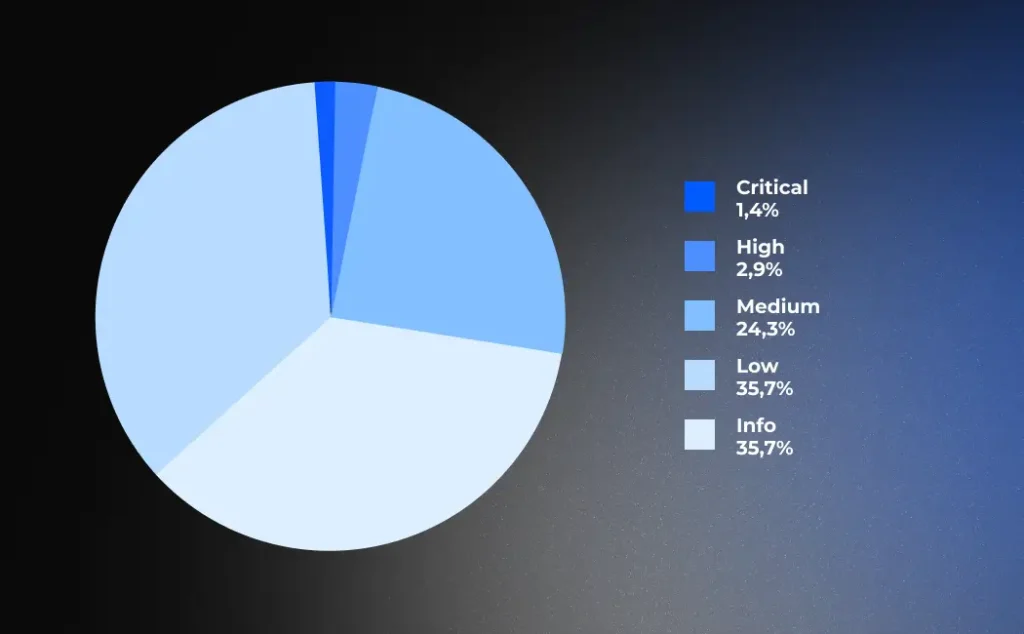
Once findings are filtered by the above factors, they can ultimately be grouped into categories by their priority. For example, critical, high, medium, low, and just informational.
4. Security Report
After the active testing phase is over, you receive the security audit report. This document includes:
- Executive summary that provides a high-level overview of your security posture for leadership and investors
- Technical findings that cover all identified vulnerabilities with explanations of why and how they can be exploited
- Risk ratings assigned to each finding based on the agreed assessment methodology
- Business impact that explains what each risk could mean in practice
- Remediation recommendations that include actionable instructions on configuration changes, encryption enhancements, secure coding practices, access control improvements, and other matters
- Prioritized roadmap that acts as a step-by-step implementation guide for introducing the fixes
What Happens After the Audit?
When you receive a security audit report, the work isn’t over yet. Actually, it’s the starting point for improving your company’s security posture. The post-audit phase includes:
- Remediation planning. Your tech leads review the prioritized roadmap and integrate vulnerability resolution directly into your existing development cycle. They schedule fixes into upcoming sprints based on their priority and risk level.
- Engineering discussions. After assembling the report, auditors meet with your team again to clear any ambiguities. They go through the findings, explain complex edge cases, discuss potential remediation approaches, and answer any questions your specialists might have.
- Follow-up reviews. While your engineers proceed with remediation, the audit team stays available to review the implementation and evaluate whether the issues are being addressed properly.
- Optional reassessment. Once you complete the remediation, you might need a re-test to ensure that all vulnerabilities have been successfully resolved. The auditors then rerun their scripts against the updated staging environment.
- Preparing for future compliance initiatives. With a patched infrastructure and an audit history, you can confidently apply for compliance certifications.
Want to act on your security audit findings? Ask SmartTek to implement the recommended improvements.
Real Client Story: Preparing an IoT Platform for a Public Sector Deployment
Let’s now consider how security assessment happens in real life and what do security auditors look for based on one of our partnerships.
Recently, we have collaborated with a global tech company that builds proprietary IoT devices and software for smart infrastructure.
Challenge
Before deploying the solution in a large public sector initiative, our client wanted an independent assessment of their security posture. Our main goal was to verify that the communication between connected devices and backend services was secure against interception or spoofing.
Scope
Since we had to deal with an interconnected hardware-to-cloud ecosystem, not a standard web app, we defined a specialized scope. Our assessment covered:
- Proprietary device communication protocols
- Cloud infrastructure configuration
- Data encryption in transit and at rest
- Access management and permissions
- Infrastructure security
- Architecture documentation and implementation
- Targeted penetration testing activities to validate flagged risks
Outcome
As a result of the security audit, our client received a report that covered identified vulnerabilities, their business impact, and prioritized remediation recommendations. Because the fixes were structured logically, our client’s team implemented them within a few months.
Conclusion
A security audit is a way to understand where your risks are and how to address them proactively. When done properly, with clear discovery and scoping, assessment and findings prioritization, as well as consistent post-audit activities, it can truly help you protect your IT infrastructure.


